Google surpassed the 72% market share level again According to the latest numbers from Experian Hitwise, Google exceeded the 72% market share level again. For Google, the May 2010 market share of 72.17% is up slightly over April. Meanwhile, Yahoo and Bing both saw slight declines according to Hitwise.

Google hasn’t been above 72% on the Hitwise chart since last December, when it reached 72.25% market share. Bing’s market share (above) of 9.23% is also its lowest since last December (8.92%).

Another interesting point raised by the Hitwise report is that Google has been delivering the most visits to the various search categories – Automotive, Shopping and Travel. Yahoo gains upstream traffic to Automotive and Shopping while Bing gains triple-digit increase in Health and Shopping search verticals.

Mobile giant Nokia is under pressure from other manufacturers in the smart-phone market sector in Finland. The American iPhone, for example, has taken over one-fifth of the market share while Asian producers also intend to follow suit.

Although some 88.7 percent of all phones used in Finland are manufactured by Nokia, a change of fortunes could be in sight, says Panu Lehti, Product Manager of service provider Elisa.

“Nokia has managed well in Finland but this position could alter if a new comparable smart-phone does not appear by next summer,” he adds.

Last week, Nokia's share price took a nosedive after the mobile phone giant slashed its outlook for its devices and services unit. Shares dropped by around 10 percent on the Helsinki and New York stock exchanges.

The 3 largest US search providers continued their long-term dominance of the online search market in May 2010, according to data from The Nielsen Company.

In total, Americans performed 9.25 billion online searches in May 2010.

Just three providers, Google Search, Yahoo Search, and MSN/Windows Live/Bing Search, accounted for slightly more than 90% of all US searches during May 2010, MarketingCharts reports. Google held a 65.1% share of the search market with 6 billion searches, its share flat from the previous month, while Yahoo came in second with 13.8% market share and 1.27 billion searches, enough to boost its share by 0.3 percentage points.

MSN/Windows Live/Bing closely trailed Yahoo with about 2 billion searches and 13% market share (up 0.1 percentage points from April 2010). The fourth-ranked provider, AOL Search, accounted for only about 191.2 million searches and 2.1% market share (down 0.4 percentage points).

Overall, the US search market showed minimal fluctuation between April and May 2010. AOL lost the most percentage points from its April market share figure and Yahoo gained the most. Four of the top 10 providers, including Google, maintained flat market share compared to the prior month.

Google's Android operating system has been gaining more and more market share lately, leaving behind older smartphone platforms on the market. While the ecosystem as a whole is moving forward, there are some changes within it that are worth mentioning. Among them, it is important to note the fact that Android 2.1 now accounts for half of the Android-based smartphones out there.

This platform version has enjoyed the largest share among other Android flavors for quite some time. Only two weeks ago, Android 2.1 accounted for around 45 percent of the devices on the market, but now it is present in a full half of them. This comes as great news for the platform, even if almost the entire other half of the phones is powered by the older Android 1.5 and 1.6 versions.

In terms of share, Android 1.5 accounts for 24.6 percent of the Android phones, while Android 1.6 for 25 percent of them. Android 1.1, 2.0 and 2.0.1 are also present in the latest report from Android Developers, with 0.1, 0.1 and 0.3 percent share, respectively. The fragmentation of the OS has been a hot topic a while ago, yet it seems that things are now moving in the right direction.

Android 2.1 has been gaining pace on the market and among other Android versions courtesy of new, highly appealing devices being released on shelves, in addition to a series of software updates that various handset vendors delivered for their devices. We've seen Motorola DROID brought up to Android 2.1, as well as phones like HTC Hero or Samsung Moment at Sprint in the US. Other devices should also enjoy the upgrade in the near future, including the European Hero or Sony Ericsson's Xperia X10 family.

With Android 2.2 (Froyo) expected to start rolling-out soon on new phones and on existing devices, things should change a little. However, Google did say at one point that Froyo and its successor, Gingerbread, were meant to bring unity to the platform, as we won't see so many new, different versions of the OS being pushed into the wild in such a short period of time.

Samsung took the lead in market share in LCD-TVs for the first quarter of 2010, according to technology research firm iSuppli Corp.

Samsung shipped 1.1 million LCD-TVs in Q1. This was down 33% from their shipment total in Q4, but outperformed the entire U.S. market, which contracted 35.8%, mostly due to seasonal factors. This helpedSamsung increase its market share from 17.3% to 18%.

Second-place Vizio saw unit-shipment declines of 42.2%, shipping just over 1 million LCD-TVs in Q1 for a 16.7% market share. Sony (11.3%), Sanyo (8%) and LG Electronics (7.8%) finished third, fourth and fifth, respectively.

Because of new product features, the average price of LCD-TVs in the United States increased by 7% to $830 in the first quarter, up from $774 in the fourth quarter of 2009.

The U.S. LCD-TV market in 2010 is set to transition away from traditional Cold Cathode Fluorescent Lamps (CCFLs) and toward LED backlighting technology. Shipments of LED-backlit LCD-TVs in the United States are projected to rise to 7.7 million units in 2010, up about 600% from 1.1 million in 2009. LED-backlit models will account for nearly one-quarter of all U.S. LCD-TV shipments in 2010, at 23.4%, up from only 3.4% in 2009.

U.S. shipments of Internet-enabled televisions are expected to rise to 11.8 million units in 2010, up from 6.9 million in 2009. Among U.S. consumers who purchased new televisions in the first quarter, 26.8% indicated their new sets were connected to the Internet, up from 24.3% in the fourth quarter of 2009.

The most popular types of Internet content accessed by consumers are movies and social networking services, according to iSuppli.

ComScore has reported this week that both Yahoo and Microsoft "gained" share in the U.S. search market for May, although both companies appear to be using gimmicks to distort the numbers in their favor.


By the numbers, Google remained the clear leader but share fell from 64.4 percent in April to 63.7 percent in May. Yahoo gained share, from 17.7 percent to 18.3 percent. Microsoft's Bing jumped to 12.1 percent, from 11.8. AOL fell marginally from 2.4 percent to 2.3.

BusinessInsider reports, however, that both companies are "gaming" the stats, by placing thousands of links on their respective homepages that are search queries pretending to be content.

Additionally, the companies have been creating image slideshows as search engines, as well, in an effort to get additional clicks.

Analyst Ben Schachter of Broadpoint Amtech says without the tricks, real search traffic numbers would have shown Yahoo falling to 16.6 percent, Microsoft holding flat at 10.8 percent and Google gaining to 66.4 percent.

Following the revelations, comScore says it will change the way it accounts for share, so the industry does not consider their work worthless.

More than 5 million e-books have been downloaded via Apple's iBookstore since the iPad device launched in the US roughly 10 weeks ago, the manufacturer claims.

Speaking at the launch of the iPhone 4, Apple chief executive Steve Job said: "Five of the six biggest publishers in the US tell us that the share of iBooks is up to about 22% — in about 8 weeks! We’re really thrilled with that." Adding that in the first 65 days, users have downloaded over 5m books, equal to about 2.5 books per iPad. There are more than 60,000 books available via the iBookstore. However, the majority of the e-books are out of copyright works, made available through Project Gutenberg.

Jobs also announced that the iPhone 4 will have access to the iBooks app. This will synch between devices, meaning the user can read across the iPad, iPhone or iPod touch. Users can also now read and store PDFs in iBooks.

Jobs heralded the iPhone 4 as "the biggest leap since the original iPhone", highlighting features such as 'Retina display', which he claimed created "the highest resolution display ever in a phone, with text looking like it does on a fine printed page".
Jobs added: "We have been dreaming about both of these breakthroughs for decades.”

The new device will be available in the US for a suggested retail price of $199 (£137) for the 16GB model and $299 for the 32GB model. It will be rolled out simultaneously in the US, France, Germany, Japan and the UK on 24th June, and countries including Australia and Canada "by the end of July".

Apple said by the end of September it aimed to have iPhone 4 available in 88 countries altogether.

New features in the iBook were also shared by the CEO. One of the features is the ability to highlight text, add bookmarks and create notes. The table of contents also has the list of all bookmarks and notes created by the user. The updated iBook will also be supporting PDF documents thereby extending the app’s ability to display books to a large number of new titles.

Baidu Inc. is targeting search growth to 79 percent market share of China by next year, based on a report from Thompson Reuters citing the company’s general manager Tang Hesong on Tuesday.

The China-based Internet search company has benefited to a great extent from the exit of Google Inc., the worldwide Internet search leader, from the world's most populous nation earlier this year.

Baidu's Internet search market share in China jumped from 58.4 percent to 64 percent from the last quarter of 2009 to the first of this year, as Google's market share dipped in the country to 30.9 percent from 35.6 percent.

If Google entirely falls off the map in China, Baidu could completely own the Internet search industry in the country, as there is no other legitimate rival currently entrenched. The next closest competitor to Baidu after Google in China is Sogou, with a microscopic 0.7 percent market share in the first quarter of 2010.

Sogou and other minor players in the China market were not able to profit from the drop off seen by Google in the first quarter.

The 70 percent market share foreseen by Baidu's GM may not be outlandish; it may actually be a conservative estimate if Google pulls out of the China market over the restrictive censorship policies.

Baidu share are up 40 cents to $70.21 in late market movement on Tuesday.

Nielsen has released their most recent smartphone OS market share numbers, and despite earlier reports, it appears that the iPhone OS still has a clear lead over Android.

Year-over-year, smartphone ownership went up from 16 percent to 23 percent of overall mobile consumers.

RIM Blackberry’s were still the clear leader, at 35 percent, but quarter-on-quarter (QoQ) the OS lost 2 percent share.

The Apple iPhone was in second at 28 percent, seeing strong 2 percent growth QoQ. Microsoft's struggling Windows Mobile platform lost 2 percent to 19 percent, but still good for third place.

The up and coming Android platform grew 2 percent, as well, to 9 percent and continues to see strong growth since its launch in late 2008.

iPhone users were the most loyal, with 80 percent saying their next phone would again be an iPhone. 70 percent on Android owners said their next phone would be an Android device again. The numbers get lower from there.

According to the latest report from NetApplications, Google's Chrome browser continues to take market share at a rapid rate, and is continuing its pace to exceed the 10 percent milestone by the end of the year.

For the month ended 31st May, Chrome moved to 7.05 percent share, up from 6.73 percent at the end of April.

Google's gain came at the expense of Microsoft's Internet Explorer and Mozilla's Firefox, which both continue to lose share on a continuing basis.

IE, which once owned 93 percent of the market, fell to 59.69 percent from 59.95 at the end of April and Firefox dropped to 24.35 from 24.95 percent.

Apple's Safari, which continues to see growth but at a very slow pace, rose to 4.77 percent from 4.72 the month before.

Additionally, IE6, the aging browser which has seen its reputation hit repeatedly over the past year fell to under 10 percent for the first time ever.

Chinese firm Founder and Taiwanese company Acer have signed a memorandum of mutual understanding in order to secure a strong foothold in a market where demand for PCs is mounting.


After announcing a range of new products in Beijing yesterday, Acer said the partnership would be equal.

It said in a statement: “Both parties intend to jointly involve Acer in the planning, development and design of Founder-brand products for more competitive offerings, such as notebooks, netbooks, mobile Internet devices and e-readers."

It said that due to the collaboration, its PC market share in the first quarter in China will rise from only 3% to 9.4% and will help narrow its gap with Hewlett-Packard's (HP's) 10.3%. However, it is unclear on how the partnership will work and whether the 2 companies will remain as single entities or merge as Acer would not give any comment about business logistics.

However it said with Founder's comprehensive distribution channels and strength in the PC market together with those in tier-four to six cities, rural areas and in segments of corporate and governmental clients, and with Acer's capability in defining and designing mobile products, the team would be able to "build up strong synergy on product offerings, supply chain and channel coverage".

It also said the partners would work together on intellectual property rights, supply chain and after-service as well as researching into the handheld PCBs and non-PC products businesses.

Lenovo is also doing very well in the Chinese market. Yesterday the Chinese company released its annual figures, where it stated that it has turned in a profit for its fiscal fourth quarter and increased its sales at the expense of other PC manufacturers.

For its fourth quarter, it made a profit of $13 million, compared to a loss of $264 million in the same quarter last year.

Sales for the fourth quarter were sharply up by 56% year on year to amount to $4.3 billion compared to $2.77 billion in the equivalent quarter last year.

However it seems not everyone is eager to copy Acer's footsteps with Asustek claiming it has no plans for a merger. Instead it is concentrating in expanding its market share through its existing motherboard and graphics card channel.

A latest report from Strategy Analysts has revealed that Sony's PlayStation 3 is increasing its global market share at the expense of Microsoft's Xbox 360.

For the first quarter of 2010, the PS3's global share shot up to 31% - a combination of the price cut,'Slim' console and AAA software such as God of War III and Uncharted 2 had been cited as catalysts for the increase. Strategy Analysts' report forecasts that Sony's platform will reach 14 million global sales, compared to 17.5 million Wiis and 10.5 million Xbox 360s.

"Our analysis shows that while Wii sales fell relative to Q109, its share in fact remained constant relative to Q409. The main movement in Q1 2010 was the growing share for Sony’s PS3, at the expense of Microsoft’s Xbox 360," said David Mercer, Principal Analyst at Strategy Analytics.

"The PS3 continues to benefit from the price cut last September. This should help the PS3 maintain growth momentum throughout 2010," Mercer added, while noting that "the introduction of the Natal technology should also help re-energize Microsoft’s Xbox 360 platform in the second half of the year."

The research firm claims that the global games market is facing "major uncertainties" for the rest of this year noting the "extent and pace of the Wii’s decline," and not knowing what kind of impact the upcoming release of the motion controls will have on consumers for both Sony and Microsoft. Strategy Analytics also believes that global video game console sales will fall by 9% by the end of this year.

HP has become the bestselling brand when it comes to servers, knocking IBM from the top spot.

Over the last year, the company gained 2.7 percent of market share, leaving it with 31.5 percent overall and $3.4 billion of revenue from its server products, according to the latest report from Gartner.

Conversely IBM managed to lose 2.1 per cent market share and dropped down to second place with 28.4 percent and just over $3 billion of revenue.

The overall server market performed well, with worldwide shipments rising by 23 percent in just the first quarter of 2010 coupled with a six per cent improvement on revenues, but it is still not quite back to the dizzy heights once experienced by the manufacturers.

"We've seen a return to growth on a worldwide level, but the market has not yet returned to the historical quarterly highs that were posted in 2008,” said Jeffrey Hewitt, research vice president at Gartner, in a statement.

The European regions had a somewhat smaller than average growth in shipments of 19.7 percent but managed to secure a 6.6 per cent growth in revenues.

Adrian O’Connell, principal research analyst at Gartner, warned that the market didn’t have as far to climb as other areas in the first place though.

“Although the EMEA server market is returning to growth in shipment and revenue terms, we need to recognise that this is growth from a low base, as the first quarter of 2009 saw a decline of 27.1 percent in shipments and a decline of 34.2 percent in revenue year over year,” he said in a statement.

“Nevertheless, current market levels remain below those seen at the start of 2008, indicating that there is opportunity for stronger penetration in the EMEA server market.”

World's number two truck maker Volvo's Volvo Trucks unit has won market share as industry order bookings revive from a plunge suffered due to the global downturn, a top executive told a newspaper on Monday.

"We have a cooperation in the business where we inform each other about order intake and our order figures show that we are winning market share," Volvo Trucks Chief Executive Staffan Jufors told Swedish business daily Dagens Industri.

Volvo, which sells trucks in separate units under its own name as well as brands such as Renault, Mack and UD Trucks, has seen demand recover in recent months from the steepest downturn in decades as the global financial crisis struck in late 2008.

"We have increased production substantially since the autumn and are now prepared for a further increase in production by 30 percent. We expect to take shares in the market," Jufors was quoted as saying by the newspaper.

The Volvo group slashed thousands of jobs to scale back costs in the face of the downturn, helping the Gothenburg-based manufacturer swing to a profit in the first quarter after a dismal 2009.

"Our profitability is better than before the economic crisis and the break-even level is considerably lower," Jufors said.

Perhaps Redmond should hurry up with IE 9. According to the most recent data from Forrester Research, business market share for Microsoft's Internet Explorer (IE6 through IE8) has slipped nearly five percent, while Firefox and Chrome are on the rise.

To keep things in perspective, that's a slip from 77.2 percent in April 2009 to 72.5 percent in March 2010,IE still has triple the market share of its nearest rival, Firefox, which enjoyed a three-percent bump, from 17 to 20 percent. As for Chrome, Google's PR folks can happily trumpet that Chrome has tripled its share: from 2.3 percent to 6.9 percent.

The former fourth competitor, Apple's Safari, is looking more and more like Mosaic 2: Doomed to get squeezed out by bigger, badder competitors. Its share has fallen from miniscule (1.25 percent) to statistically insignificant (less than one half of one percent).

The big question, then, is what's fueling the move away from IE and toward competitors. Forrester offers some suggestions -- Firefox's bevy of add-ons, Chrome's speed and features for so-called "tech-savvy, empowered workers," and the security issues that have plagued IE. And it's worth noting that browser market share isn't a zero-sum game, since plenty of people use more than one browser. Still, IE's share is shrinking, and users usually don't jump ship unless they are unhappy.

And failing an incredibly irresistible IE 9, it's hard to imagine IE's share recovering. As InfoWorld's Neil McAllister says, "People who start using IE do it because it's there; it's the lazy option. People who do not to use IE are probably not going to go back to IE, because they have already made a choice not to. So unless the total number of people using Windows is growing measurably, IE's market share cannot go up. It can only go down."

According to a Billboard report, Apple has continued to gain market share among music distributors in the US. Apple's market share rose to 26.7 percent in 2009, up from 21.4 percent in the previous year.

Walmart still holds the second spot, although the company's market share has continued to decline to 12.5 percent. Other retailers, such as Best Buy, showed similar lackluster numbers, as many moved to scale back floor space dedicated to CD sales.

Amazon's performance improved slightly in 2009, with market share rising from 4.9 percent to 7.1 percent. The company's digital distribution, when seen as a separate entity, nearly doubled its take to reach 1.3 percent, although still falling short of iTunes. The company has still proven incapable to put a dent in Apple's sales, despite previous analyst expectations.

Apple's move to allow variable pricing on iTunes tracks has been credited as a key factor behind the 2009 increase, although it remains unclear if the company will maintain strong momentum despite an overall decline in digital sales.

Gartner's Q1 2010 Smartphone Sales Chart
Gartner released a new report that detailed worldwide smartphone sales to end users by operating system during the first quarter of 2010.

The research firm found that Android's marketshare rose from 1.6% during the first quarter of 2009 to 9.6% during the first quarter of 2010. That pushed Google's operating system past Microsoft's Windows Mobile, which had a 10.1% market share during the first quarter of 2009 and fell to just a 6.8 percent share during Q1 2010. Apple's iPhone OS X had a 15.4% share during the first quarter, up from a 10.5% share in Q1 2009.

Nokia and RIM have the greatest OS share globally. Nokia's Symbian OS has a current share of 44.3%, down from 48.8% during Q1 2009, and RIM's OS share is 19.4%, also down from the 20.6% share it held in the first quarter of 2009.

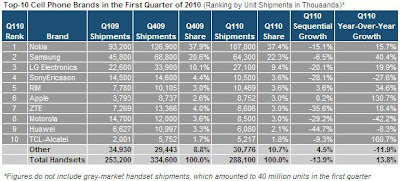
Apple's 8.75 million iPhones shipped in the first 3 months of 2010 managed to edge Motorola, which sold 8.5 million handsets during the same period, according to new data from iSuppli. During the quarter, Apple was the No. 6 overall cell phone maker in the world, while Motorola came in at 8. iSuppli called Apple's growth in the global market a "changing of the guard" in the cell phone industry.

Apple was propelled by 130.7 percent year-over-year growth, up notably from the 3.79 million iPhones sold in the first quarter of 2009. The Cupertino, Calif., company still remains behind Research in Motion, which has 3.6 percent of the market with 10.47 million BlackBerrys sold in the first quarter of 2010.

The numbers serve to demonstrate what a small portion smartphones are of the overall cell phone market. The top global brand during the quarter was Nokia, which sold a total of 107.8 million cell phones and smartphones during the quarter. Competitors Apple and RIM, however, do not sell traditional cell phones.

The latest numbers also demonstrate how far Motorola has fallen: In the first quarter of 2007, the company was the second-largest cell phone shipper in the world, behind only Nokia. Recently, Motorola has shifted its focus to higher margin smartphones, like the Droid.

The report noted that the smartphone market is expected to continue to grow, which could result in both RIM and Apple ousting some of the biggest players in the global cell phone market. Within their sights is No. 4 Sony Ericsson, which has 3.6 percent of the market, but fell 27.6 percent year-over-year in the first quarter.

Samsung Electronic’s share of the U.S. mobile phone market exceeded 30% for the first time ever in the first quarter.

According to market researcher Strategy Analytics on Sunday, Samsung sold 12.3 million handsets in the U.S. in the first 3 months of the year, taking up 30.1% of the market.

The company grabbed a 26.5% share of the Canadian market in the quarter by selling 600,000 units.

With a combined market share of 29.9% in the U.S. and Canada, Samsung has maintained the top position in the North American market for seven quarters in a row.

LG Electronics sold 7.9 million mobile phones in North America to come in second place with an 18.3% share.

Research In Motion, maker of the Blackberry smartphone, was in third with 11.8%. By selling 5.1 million handsets, RIM edged out Motorola for the first time. Motorola came in fourth with sales of 4.7 million units and a 10.9% market share. Apple, with a market share of 7.1%, was fifth with sales of 3.1 million iPhones.

Swiss food behemoth Nestle(NSRGY) is seeking to intensify its imprint in the $6.6 billion U.K. confectionery market even though its competitors are becoming bigger and stronger, a report says: the new Kraft(KFT) and Cadbury entity is one example, of course.

Nestle aims to increase its share in the U.K. confectionery market by up to 0.2% points a year from the current 16%, the report says.

Meanwhile, Kraft has seen its U.K. share shoot up to about 30% from just 2% to 3% after buying Cadbury earlier this year, and Mars saw its market share rise to 24% after buying Wrigley two years ago.

"The two moves have concentrated the players, but not concentrated the brands. Consumers still have a similar number of brands to choose from," Nestle's head of U.K. and Ireland confectionery David Rennie told Reuters at Nestle's York plant in northern England.

A challenge for Nestle is coming in the form of climbing commodity prices, like that of cocoa, which is a key ingredient for the maker of KitKat, Crunch and Smarties. Still, despite all the growing competition and raw material pressures, the company says it won't be cutting any jobs for the sake of gaining competitive edge, Reuters says.

Nestle stock is down 2% to $46.58, while Kraft is 1.5% lower at $29.85.

Marketers in the U.S. considerably increased their spending on online display ads in the first quarter, as social networking leader Facebook served up the most impressions of this type of ad, according to comScore.

Display ad impressions rose 15% in the first quarter, year-on-year, to 1.1 trillion and spending on this ad format totaled US$2.7 billion, or $2.48 per thousand impressions (CPM).

Facebook grabbed a 16.2% share of impressions, edging former leader Yahoo, which nabbed 12.1% of the total. This represents quite a change from 2009's first quarter, when Yahoo had a 13% share and Facebook ranked third with 7.5%.

Yahoo has traditionally been the market leader in display advertising, an ad format that includes rich media ads, static banners and that generates a major portion of the company's revenue.

Yahoo didn't immediately respond to a request for comment regarding comScore's findings, although it's safe to assume that Yahoo executives can't be thrilled to see Facebook serving up so many more display ads, which are vital to Yahoo's financial well-being.

Microsoft finished third in this year's first quarter, with 5.5%, up from 4.6% in last year's first quarter. Fox Interactive Media, which includes MySpace, saw its share stumble from 11.6% in 2009's first quarter to 4.9%. AOL finished fifth and its share also fell, from 6.3% to 2.9%. Neither MySpace nor AOL immediately responded to requests for comment.

Ranking sixth with 2.4% was Google, which has been trying furiously for years to beef up its display ad business and diversify its revenue stream, which depends overwhelmingly on pay-per-click text search ads.

Reporting a 63% profits raise in its third quarter results Wednesday, Cisco Systems said it has been gaining market share and predicted the favorable conditions would continue in its next quarter.

Revenue in the third quarter jumped to $10.37 billion from $8.2 billion in the third quarter last year while income rose to $2.2 billion against $1.35 billion last year. The results generally beat predictions of investment banking analysts who follow the networking giant.

"We witnessed a return to strong balanced growth across geographies, products and customer segments that we haven't seen since before the global economic challenges began," said Cisco's chairman and CEO John Chambers in a statement. "We emerge from this downturn gaining market share, a larger share of the total wallet spend of our customers, dramatically improved customer relations as a trusted technology and business partner, and having next-generation products in almost every product category."

The company cited its acquisition of video communications provider Tandberg as a high point in the quarter. Cisco paid $3.3 billion for Tandberg after a lengthy and sometimes bruising struggle with the Norwegian firm's stockholders. Tandberg's video conferencing systems beefed up Cisco's already sturdy presence in video conferencing and Telepresence.

Cisco also singled out its accelerating partnership with VMware in which the two firms are cooperating to deliver Cisco's Unified Computing System and VMware vSphere. VMware is majority-owned by storage pacesetter EMC, which is moving aggressively with Cisco to stake out positions in data centers and cloud computing.

In the earnings report, released after the close of stock markets Wednesday, Chambers added: "From almost every measurement perspective - revenues, earnings per share, new products, successful acquisitions, internal startups -- our results in Q3 were the proof points that our strategy is working and was probably the strongest quarter in our history."

Yahoo Inc. (YHOO) increased its share of the Internet search market in April compared with the previous month, mostly at the expense of sector giant Google Inc. (GOOG).

According to monthly data from comScore Inc. (SCOR), Google remained the market leader by a wide margin, powering 64.4% of U.S. searches. But its share fell 0.7 percentage point from March, while that of Yahoo rose 0.8 point to 17.7%. Microsoft Corp. (MSFT) increased its share of searches by 0.1 point to 11.8%.

Yahoo has been posting share gains as it begins to reap rewards from a search pact with Microsoft.

During the first quarter, Yahoo launched its 10-year revenue-sharing partnership. Under the pact, Microsoft's Bing will power searches on Yahoo's Web properties. And the Bing engine started chipping away at Google's broad lead after a splashy launch last summer.

Ask Network, owned by IAC/Interactive Corp. (IACI) captured 3.7%, followed by AOL Inc. (AOL) at 2.4%--both were down 0.1 point.

Analysis firm comScore has released the latest mobile subscriber market share numbers, for the month ended March 31st, 2010.

At the end of the period, there were 234 million Americans with mobile phones, with the most popular manufacturer, by fractions, being Samsung at 21.92 percent.

In second place was Motorola with 21.9 percent, and LG just as close behind with 21.8 percent.

Rounding out the top 5 was RIM at 8.3 percent and Nokia at the same percentage. Apple, with only one phone available, came in sixth at 5 percent.

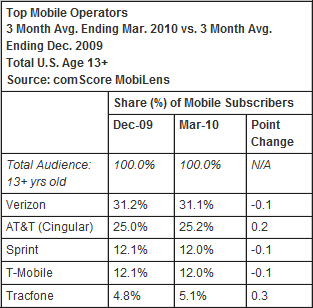
As for top carriers, Verizon led the way at 31.1 percent, AT&T came in second at 25.2 percent, and Sprint and T-Mobile tied for third at 12 percent. Tracfone rounded out the top 5 with 5.1 percent, seeing the biggest growth of all the carriers.

Newer Posts Older Posts Home